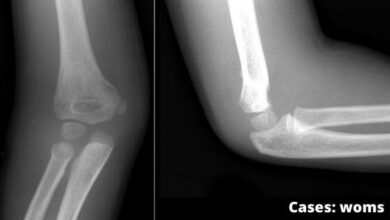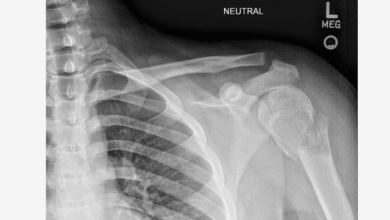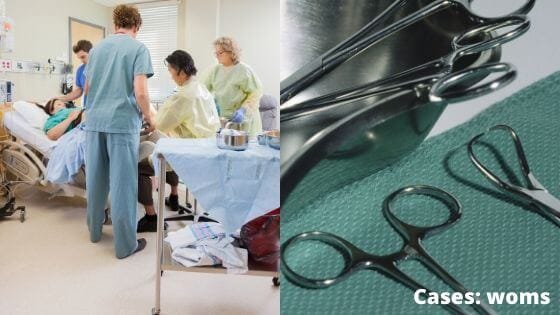
A baby boy was delivered in a hospital by an obstetrician by pulling the baby’s head using forceps (forceps delivery). Two weeks later the parents took the baby to the pediatrician for a check-up. While examining the baby the pediatrician found that the baby’s right arm was medially rotated and adducted, while his forearm was extended and pronated. He also noticed sensory loss on the lateral aspect of the right upper limb.
Questions
- Name the position of the upper limb of the baby observed by the pediatrician.
- What is the clinical condition called?
- Name the site of lesion and the cause that produced this condition.
- What is the cause of sensory loss in the upper limb?
Answers
- Erb’s palsy deformity, also known as Policeman’s tip hand, Porter’s tip hand, or Waiter’s tip hand.
- Erb’s paralysis (or Erb’s palsy).
- Erb’s point due to the excessive separation of the neck and shoulder caused by pulling the baby’s head during delivery.
- Involvement of the C5 and C6 spinal nerves (specifically the upper trunk of the brachial plexus). The sensory loss occurs due to the involvement of the lateral cutaneous nerve of the forearm, which carries fibers from these roots.
Clinical Note: Erb’s point is an anatomical location on the upper trunk of the brachial plexus where six nerves meet. In a difficult forceps delivery, excessive lateral traction on the head stretches or ruptures these nerve roots, leading to the classic “waiter’s tip” posture due to paralysis of the abductors, lateral rotators, and flexors of the upper limb.