Axillary Nerve

A 45-year-old man, a chronic user of a crutch went to his family physician and complained that he had noticed a loss of shoulder contour on the right side during the last 2 months. He also told me that he feels no sensations in this region and could see the bony projection at the upper end.
On examination, the physician found that the patient could not abduct his arm up to 90° and there was a loss of skin sensation. Over the lower half of the deltoid muscle. He could also notice the prominence of the greater tubercle of the humerus. He was diagnosed as a case of axillary nerve injury.
Questions
1. Mention the origin and root value of the axillary nerve.
2. What are the three common causes of axillary nerve injury?
3. Mention the cause of loss of skin sensation over the lower half of the deltoid.
4. What is the cause of loss of shoulder contour and prominence of greater tubercule humerus?
5. Name the muscles supplied by the axillary nerve.
Answers
- The axillary nerve arises from the posterior cord of the brachial plexus (C5 and C6).
- The axillary nerve can be injured by:
- The upward pressure of a badly adjusted crutch into the armpit.
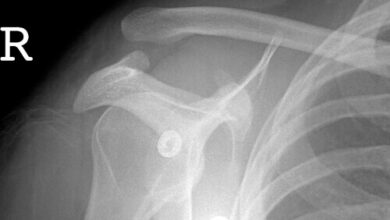
- Inferior dislocation of the shoulder joint.
- Improper intramuscular injection into the deltoid muscle.
- Due to involvement of the upper lateral cutaneous nerve of the arm.
- Due to the atrophy (wasting) of the deltoid muscle. Without nerve stimulation, the muscle loses its bulk, flattening the shoulder contour and making the greater tubercle of the humerus prominent.
- Deltoid and teres minor. (The axillary nerve passes through the quadrangular space alongside the posterior circumflex humoral artery. Understanding its anatomical course is essential for clinicians to avoid iatrogenic injuries during shoulder surgeries or deltoid injections.)