What Makes Peptides a Serious Bioactive Option in Modern Therapeutics?
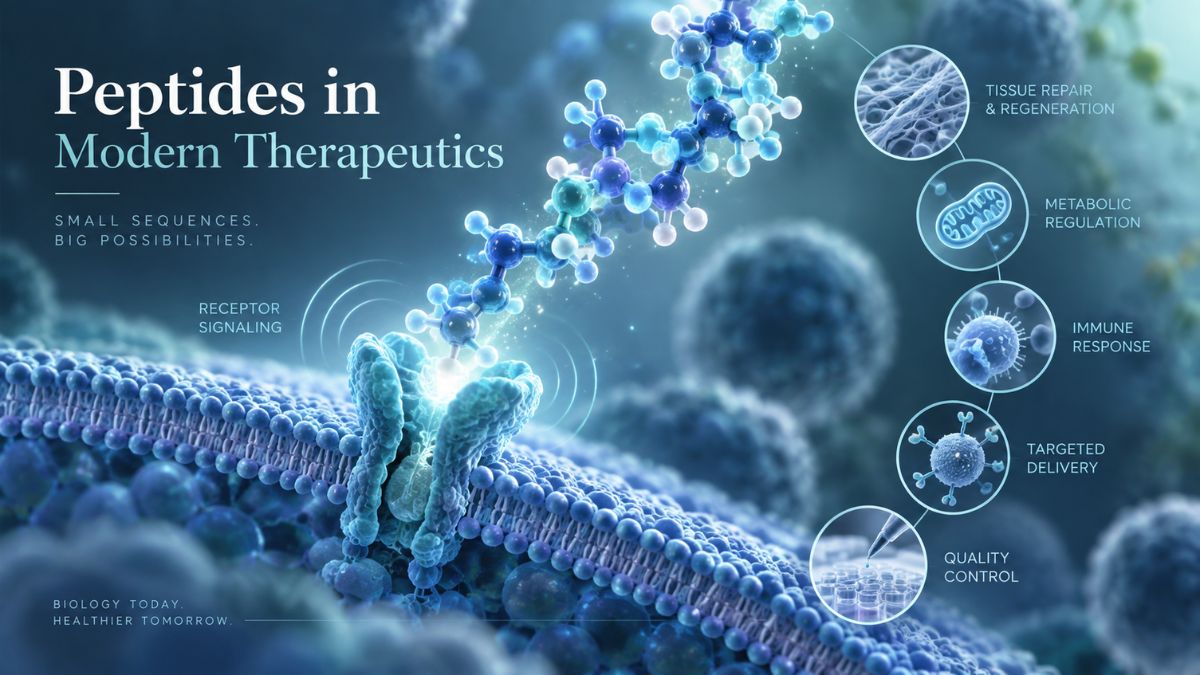
While healthcare is not entirely abandoning traditional, modern solutions are shifting away from the medication of active destroyers of disease causing elements, to leveraging biological messengers that instruct the body’s own cells to respond. Peptides fit naturally into that conversation, not because they are fashionable, but because they allow a more specialized way of thinking.
Biomimetic Peptides Mimic the Body’s Natural Signals
There is something that makes peptides integrate smoothly into physiological systems. Since synthetic peptides mimic body’s biological activities, they benefit from a distinct biological head start. For example, they can easily leverage pre-existing pathways while navigating unique target delivery challenges.
That gives researchers something meaningful to work with. Depending on the peptide, peptides can help control core biological functions and maintain health. That may involve processes such as:
- Receptor signaling
- Tissue repair and regeneration
- Metabolic activity
- Immune and inflammatory responses
However, synthetic peptides are not the exact human version of peptides. Hence, biological familiarity is not a guarantee of reliability. That calls for careful evaluation of the best peptides that achieve more targeted interventions safely.
Peptides Are Interesting Precisely Because They Are Not All the Same
This is where some of the conversation around peptides goes off track. “Peptides” is an enormous category. Treating them as though they were one product or one type of therapy makes about as much sense as treating every pharmaceutical compound as interchangeable simply because they are all drugs.
Different peptide sequences can behave differently. They can interact with different receptors and biological pathways, opening very different areas of research.
So, instead of asking, “Do peptides work?” A more serious question is:
Which peptide? For what purpose? Under what conditions? And what evidence supports its use?
That shift from enthusiasm to specificity is important. A formulation that makes sense for one biological objective may be completely unsuitable for another. Good peptide work starts with the scenario, not the sales pitch.
Sometimes the Delivery System Is as Important as the Molecule
Here is the part that is easy to miss: Identifying a promising peptide molecule is only the beginning. The resilience within the delivery system matters in ensuring high bio-availability. That’s where quality modified peptides become foundational.
That is because the body has plenty of ways to interfere with a molecule’s plans. It can break it down, limit absorption, prevent it from crossing certain biological barriers, or clear it from circulation before it has much opportunity to act.
That is why peptide development increasingly looks at the whole delivery equation:
- Can the molecule remain stable?
- Can enough of it reach circulation?
- Can it reach the intended tissue or cellular environment?
- Can exposure be maintained for an appropriate period?
This is not simply a technology contest. The seemingly easiest route of peptide administration is not automatically the best one, but one which accommodates the molecule, serves the intended therapeutic objective, and minimizes wastage.
Reliability Is Built Long Before Anyone Uses the Product
This is perhaps the least glamorous part, and one of the most important. A peptide’s performance claims are compromised if its identity, purity, concentration, stability, or manufacturing quality cannot be properly established. When sourcing, quality assurance has to extend beyond attractive packaging and impressive assay.
Look for a process built around:
- Verified identity and purity
- Appropriate analytical testing
- Consistent manufacturing controls
- Traceable sourcing and documentation
- Claims that remain proportional to the evidence
That is where professionalism shows itself. Reliable peptide solutions are not created by selling a molecule quickly. They are built through careful sourcing, validation, formulation expertise, and a willingness to say when the evidence is still developing.
In essence, peptides are not compelling because they are biologically familiar. Their real value lies in the opportunity to investigate more precise biological strategies. That does not mean every new bio-therapy deserves a place at the table. It means researchers are getting better at understanding how the body responds, where problems actually occur, and what kind of intervention makes sense.